Evaluating Moose, Forest and Mountain, Wildlife SVG for Creative Projects
The intersection of nature-inspired design and digital crafting has created a robust market for high-quality vector graphics. Among the most sought-after themes are those that capture the rugged beauty of the wilderness. Specifically, designs featuring a Moose, Forest and Mountain, Wildlife SVG offer a compelling blend of iconic wildlife imagery and scenic landscape elements. For crafters, small business owners, and DIY enthusiasts, selecting the right digital asset is not merely about aesthetic preference but also about technical compatibility, versatility, and end-use application.
This analysis explores the specific attributes of the Moose, Forest and Mountain, Wildlife SVG collection provided by GPDigitaline, examining its file formats, resolution capabilities, and practical applications. By comparing these features against general industry standards for cutting files, we can determine where this resource fits within the broader ecosystem of digital design tools and what tradeoffs users should consider before purchasing.
Understanding the Core Design Elements
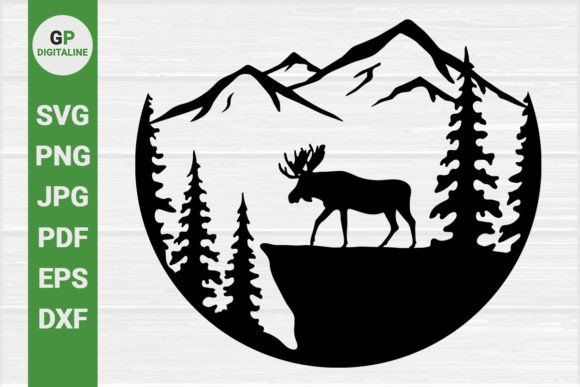
At its heart, the Moose, Forest and Mountain, Wildlife SVG is a composite scene rather than a simple icon. It integrates multiple visual layers: a central moose figure, surrounded by woodland elements such as pine trees, rolling hills, and distant mountain peaks. This complexity distinguishes it from single-subject silhouettes often found in free or low-cost clipart libraries. The design captures a "wilderness" atmosphere, appealing to audiences who value outdoor aesthetics, hunting culture, or rustic home decor.
The artistic style is defined by clean lines and distinct shapes, which is critical for cut files. Unlike raster images (like standard JPEGs) which rely on pixels, the vector nature of the primary SVG format allows for infinite scaling without quality loss. This means the same file can be used for a small sticker on a water bottle or a large vinyl decal on a truck window without becoming pixelated or blurry. The color profile is specified as black RGB, indicating a monochromatic silhouette approach. While this limits immediate color variation, it maximizes contrast and ensures that the design remains legible regardless of the substrate material—whether it is white vinyl, dark wood, or colored fabric.
File Format Analysis and Technical Versatility
One of the strongest selling points of this particular listing is the comprehensive suite of file formats included in the ZIP package. Understanding the role of each format helps users evaluate whether this product meets their specific technical needs.
- SVG (Scalable Vector Graphics): As the primary format, the SVG is essential for modern cutting machines like Cricut and Silhouette. It contains the mathematical instructions needed to guide the blade or laser. Its ability to resize without quality loss makes it the most versatile file in the set.
- PNG (Portable Network Graphics): Included at 3600 x 3600 pixels with a transparent background, the PNG serves as a high-resolution reference image. It is particularly useful for sublimation printing or direct-to-garment (DTG) printing, where the software requires a raster image with transparency to overlay the design onto colorful fabrics.
- JPEG: Providing a version with a white background, the JPEG is ideal for standard printing workflows, such as creating physical greeting cards or posters where a solid backdrop is required. Like the PNG, it maintains the 300 DPI resolution necessary for crisp print output.
- PDF and EPS: These formats cater to professional graphic designers and laser engravers. The EPS10 vector data ensures compatibility with Adobe Illustrator and other desktop publishing software. Users who need to edit the paths, combine this design with other text elements, or prepare files for industrial laser cutting will find these formats indispensable.
- DXF: Often used in conjunction with CAD software or specific laser cutting programs, the DXF file offers an alternative vector structure that some older or specialized machines prefer over SVG.
When comparing this bundle to competitors, the inclusion of both raster (PNG/JPEG) and vector (SVG/EPS/DXF/PDF) formats in a single purchase is a significant advantage. Many listings offer only one or two formats, forcing users to either pay extra for additional files or struggle with conversion tools that may alter the original design integrity.
Comparing Approaches: Single-Subject vs. Scene-Based Designs
In the realm of woodland animal art, creators generally choose between two approaches: isolated subject matter or integrated scenes. An isolated moose silhouette focuses entirely on the animal’s form, making it easier to integrate into complex layouts or mix with other icons. Conversely, the Moose, Forest and Mountain, Wildlife SVG adopts a scene-based approach.
Advantages of the Scene-Based Approach:
- Immediate Visual Impact: The design tells a complete story. A customer looking for cabin decor does not need to source separate tree and mountain graphics; they have a cohesive landscape ready to use.
- Reduced Layer Management: For beginners using cutting software, managing dozens of individual layers (one for each pine needle or rock) can be tedious. A pre-composed scene reduces the number of layers the user must organize, speeding up the production workflow.
- Thematic Consistency: The integration of hills, woods, and wildlife ensures a balanced composition that is difficult to achieve when manually arranging disparate elements.
Tradeoffs and Limitations:
However, this cohesion comes with flexibility constraints. If a crafter wants to use just the moose head on a mug and the forest on a shirt, they cannot easily separate the elements if the SVG is grouped as a single compound path. While the EPS and PDF files allow for editing, users must possess advanced vector editing skills to ungroup and isolate specific components. In contrast, simpler, single-element SVGs offer greater modularity for mixed-media projects.
Application Scenarios and Market Fit
Deciding whether the Moose, Forest and Mountain, Wildlife SVG is the right choice depends heavily on the intended end product. The following scenarios highlight where this design excels and where it might present challenges.
Ideal Use Cases
Wood Signs and Plaque Engraving: The high-contrast black design works exceptionally well on natural wood backgrounds. Laser engravers can utilize the SVG or DXF files to carve the intricate details of the pine trees and mountains into plywood or pine boards. The scene-based layout fills the surface area effectively, creating a striking rustic sign.
Outdoor Apparel: For t-shirts or hoodies targeting outdoorsmen, hunters, or nature lovers, the silhouette provides a bold, recognizable graphic. The black-on-color contrast ensures visibility and durability through washing cycles, especially when using heat transfer vinyl (HTV).
Stationery and Cards: The included JPEG and PNG files allow for easy insertion into card design software. The 300 DPI resolution ensures that fine details, such as the texture of the moose’s antlers or the needles of the pine trees, remain sharp when printed on high-quality cardstock.
Limited Suitability
Multi-Color Screen Printing: Because the design is monochromatic (black RGB), it is less suitable for projects requiring full-color photographic realism or multi-layer screen printing unless the user plans to add significant post-processing color work.
Small-Scale Jewelry: While possible, the level of detail in the forest and mountain elements might be lost on very small items like pendants or earrings. Users should test-print or simulate the size in their software to ensure the fine lines do not become indistinguishable blobs at miniature scales.
Evaluation of Quality and Professional Standards
A common concern in the digital download market is the presence of watermarks or low-resolution artifacts. The description explicitly states that the files do not contain watermarks, a crucial factor for commercial use. Additionally, the claim of "unlimited resizing with no quality loss" applies specifically to the vector formats (SVG, EPS, DXF). Users should verify that their chosen software supports these formats natively. For instance, basic image viewers may not open DXF files, requiring dedicated CAD or vector editing software.
The specification of 12x12 inches at 3600 pixels equates to exactly 300 DPI, which is the industry standard for high-quality printing. This consistency across PNG and JPEG files suggests a professional workflow from the creator, GPDigitaline. However, users should always check their specific machine’s limitations. Some entry-level Cricut machines may struggle with extremely dense vector areas, potentially leading to blade clogging or incomplete cuts. Testing on scrap material is always recommended.
Conclusion on Value and Decision Factors
The Moose, Forest and Mountain, Wildlife SVG represents a well-rounded asset for creators focused on rustic, outdoor-themed projects. Its strength lies in its comprehensive file delivery and cohesive design narrative. It eliminates the need for users to hunt for matching landscape elements, providing a ready-made scene that is technically robust across various manufacturing methods, from vinyl cutting to laser engraving.
For those seeking modular, single-element icons, this design may feel too complex or restrictive. However, for individuals aiming to produce finished, thematic products quickly—such as cabin signs, themed apparel, or nature-inspired stationery—it offers significant time savings and professional-grade results. When evaluating this option against alternatives, consider the balance between the convenience of an all-in-one scene and the flexibility of separate, editable components. If your project benefits from a unified visual story and you require versatile file types for diverse production methods, this SVG bundle stands out as a practical and efficient choice.